You built the income. Now let's make sure you keep as much of it as possible. 🖤

A friend messaged me not long ago.
She'd been posting her outfits online for a few months - building a following, creating content she genuinely enjoyed, and slowly catching the attention of brands. Over the course of that tax year TikTok Shop had generated around £800 in income from her views and content.
Then an offer came in. A brand wanted UGC content - User Generated Content, for anyone who hasn't heard the term - paying £250 for the job.
She was excited. Obviously. And then almost immediately - the message came through.
"Wait. Does this mean I need to tell HMRC? Surely not - I've only gone over by £50 in the whole year. That's nothing. They can't actually care about £50 can they?"
Here's the honest answer.
HMRC doesn't have a "it's only £50 over" exemption. The £1,000 trading allowance is a threshold - and once you cross it the rules apply regardless of how far over you are. Fifty pounds over or five thousand pounds over - the obligation is the same.
But - and this is important - crossing that threshold doesn't mean you have a devastating tax bill. It means you need to register and declare. What you actually owe is a completely different calculation.
And that's what this receipt is going to show you. 🖤
The £1,000 trading allowance - the line most people don't know exists
Every UK individual gets a £1,000 trading allowance each tax year. This is based on your total annual revenue - everything that comes in across the full April to April tax year - not a monthly figure.
If your total side hustle revenue for the year is under £1,000 - you're covered. No registration required. No Self Assessment needed.
Over £1,000 in revenue for the year - and the conversation changes.
My friend's situation across the full tax year:
TikTok Shop and views: £800
UGC content deal: £250
Total annual revenue: £1,050
£50 over the £1,000 threshold.
That's when HMRC needs to know.
But here's where most people get confused - and where the panic is almost always bigger than it needs to be.
Revenue vs taxable profit - the distinction that changes everything
Crossing the £1,000 threshold does not mean you pay tax on everything that came in. This is the single most misunderstood thing about side hustle tax - and getting it wrong causes unnecessary panic or worse, people making incorrect calculations about what they actually owe.
So let's be completely clear.
Revenue is everything that comes into your side hustle. Every payment. Every brand deal. Every TikTok Shop payout. The total before anything is deducted.
Allowable expenses are the legitimate costs of running your side hustle - equipment, software, a proportion of your phone bill, travel for work purposes and more. We'll cover these shortly.
Taxable profit is revenue minus allowable expenses.
Revenue - Allowable expenses = Taxable profit
Tax is only due on taxable profit.
Not your total revenue.
Not everything that hits your bank account.
Just the profit.
A content creator turning over £3,000 in a year with £1,200 of legitimate business expenses has a taxable profit of £1,800 - not £3,000. That's a significantly different tax position.
Know your revenue. Know your expenses. The number that actually matters is the profit.
When and how to register
If your side hustle revenue exceeds £1,000 in a tax year - you need to register as self employed with HMRC and complete a Self Assessment tax return.
The key dates:
5th October
Register as self employed by this date in the tax year after you started earning. So if you started earning in the 2024/25 tax year - register by 5th October 2025.
31st January
File your online Self Assessment and pay any tax owed by this date.
Miss it and HMRC charges automatic penalties - even if you owe nothing.
These dates go in your calendar today.
How to register - it's simpler than it sounds:
Go to gov.uk
Search "register as self employed"
You'll need your National Insurance number and basic personal details.
HMRC will issue you a UTR number - your Unique Taxpayer Reference.
Keep it. You'll need it every year.
The whole process takes around 10 minutes. The anxiety around it almost always takes significantly longer than the registration itself. Do it now — before January makes it feel urgent.
The receipt - what side hustle tax actually looks like in real numbers
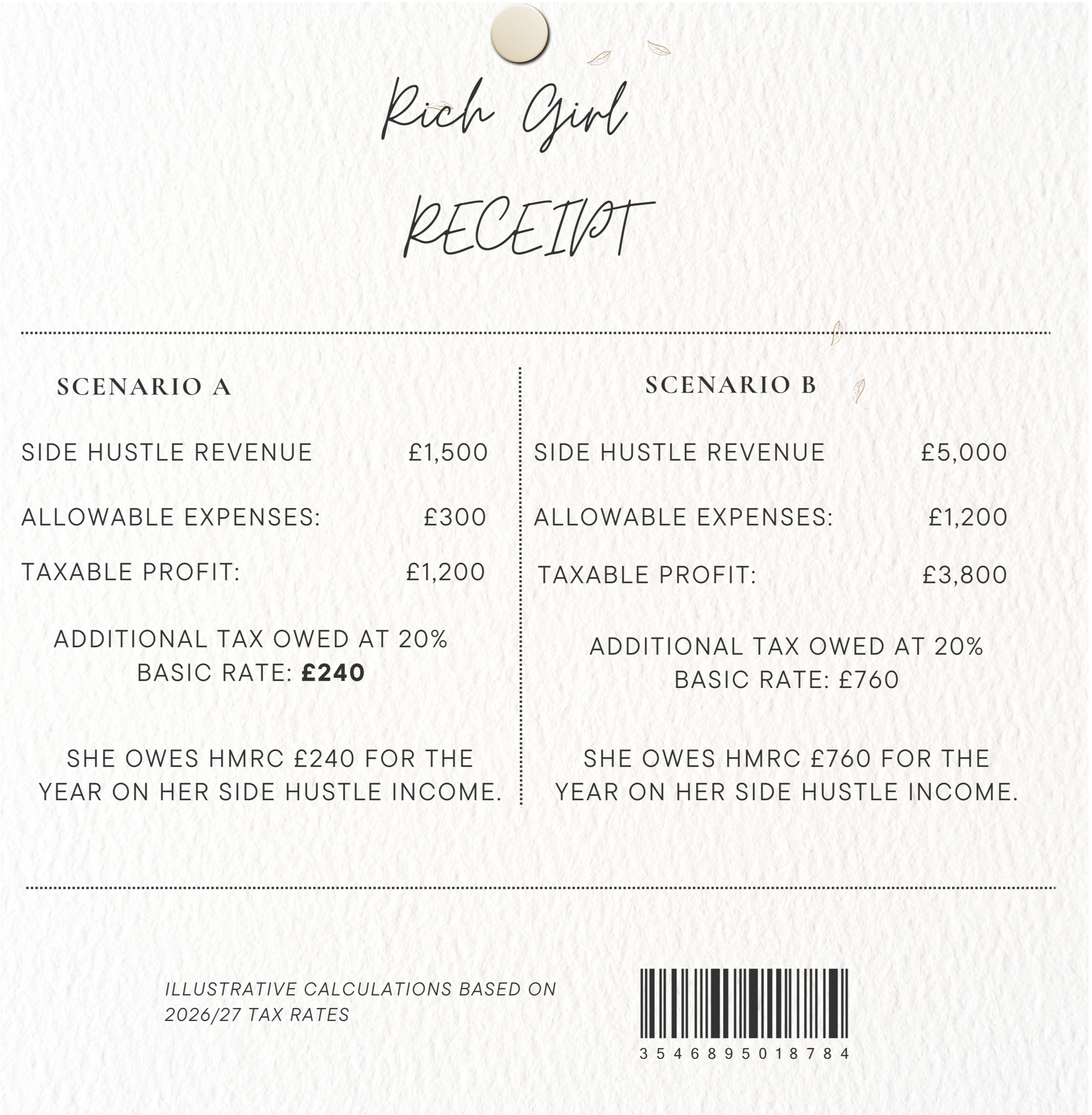
Both scenarios below involve a woman with a full time salary of £30,000 and a side hustle. Her salary tax is already handled by her employer through PAYE. What we're looking at here is the additional tax on her side hustle income only.
Note: National Insurance contributions on self employed income may also apply above
certain thresholds. Check current rates at gov.uk.
These numbers are manageable. They are not the financial catastrophe most women fear when they first start thinking about declaring. They're a percentage of profit you've already earned - and profit built from something you created.
The receipt for not declaring is considerably less manageable. We'll get to that shortly.
What expenses you can legitimately claim
This is the section that can meaningfully reduce your tax bill - and the one most side hustlers either don't know about or don't use properly.
Allowable expenses are costs that are wholly and exclusively for the purpose of your business. Here are a few examples across common side hustle types - this isn't an exhaustive list but gives you a starting point:
Content creation / social media:
Camera, lighting, editing software, props purchased specifically for shoots, a proportion of your phone bill used for business purposes, travel to brand events or shoots.
Selling products (Etsy, Depop etc):
Materials, packaging, postage costs, platform fees and charges.
Freelancing / UGC / design:
Software subscriptions, equipment, a proportion of phone and broadband, travel to client meetings, relevant training or courses.
The key rule across all of them - the expense must be wholly and exclusively for business purposes. If you're ever unsure whether something qualifies, speak to a qualified tax adviser about your specific circumstances.
We'll be covering expenses in more depth in a future receipt - if there are specific expense questions you'd like us to cover, let us know. 🖤
The receipt for not claiming what you're entitled to
This example shows what happens when someone fails to put through allowable expenses that could have legitimately reduced their taxable profit - and therefore their tax bill. Missing these deductions means paying tax on income you didn't need to pay tax on.
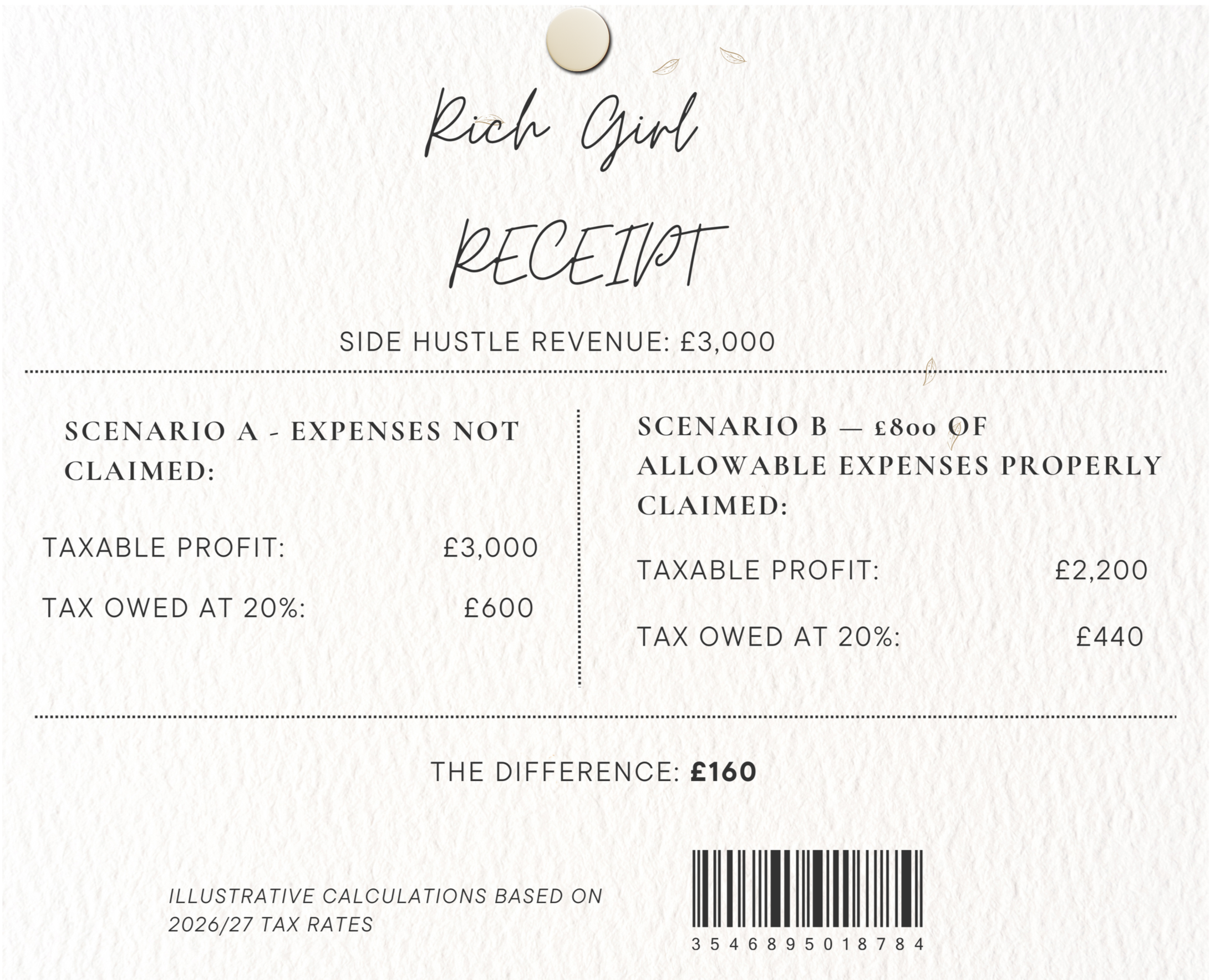
£160 you didn't need to pay -
simply because the expenses
weren't recorded and claimed.
Every year. On the same income.
The expenses were always there. The cost was always legitimate. The only difference is whether you recorded them and claimed them properly.
Keep your receipts. 🖤
The content creator specific note
If you're a content creator - this section is for you.
Gifted items, paid collaborations, affiliate income, brand deals, TikTok Shop payouts, YouTube ad revenue - all of it counts as declarable income once you're over the £1,000 threshold. HMRC considers gifted items to have a monetary value and that value is declarable.
This surprises a lot of creators who assume that because no money physically changed hands the gift doesn't count. It does.
HMRC has significantly increased its data sharing with digital platforms in recent years. The receipt for assuming you won't be noticed is not one worth taking.
Declare it. Claim your expenses. Pay what you owe. Sleep well. 🖤
Self Assessment - without the panic
Self Assessment sounds more intimidating than it is. Most women who've been through it once wonder what they were so worried about.
Here's the process simply:
1. Register at gov.ukas soon as your revenue exceeds £1,000.
Don't wait until January.
2. Keep records throughout the year.
Every invoice. Every expense.
Every payment received.
A simple spreadsheet works.
3. Complete your return online between April and 31st January.
Enter your income and expenses.
HMRC calculates what you owe.
4. Pay by 31st January.
That's it.
The penalties for missing the deadline:
1 day late: £100 automatic penalty
3 months late: Additional £10/day
6 months late: 5% of tax owed
12 months late: Further 5% of tax owed
These apply even if you owe nothing.
Even if your taxable profit is zero.
The filing itself is significantly less complicated than the anxiety around it suggests. The key is keeping records throughout the year so January is an admin task - not a crisis.
Save for your tax bill - the most practical thing in this receipt
Every time money comes into your side hustle - set a percentage aside immediately. Not at the end of the year. Not when you remember. Every single payment.
Basic rate taxpayer (total income under £50,270)
→ Set aside 25-30% to cover income tax and National Insurance contributions
Higher rate taxpayer (total income over £50,270)
→ Set aside 40-45% of every payment to cover income tax and Class 4 National Insurance
If you have a full time salary alongside your side hustle - your NI position may differ. Check gov.uk or speak to a tax adviser for your specific position.
Open a separate easy access savings account - keep it distinct from your current account so the money is visible but not tempting - and transfer the percentage the moment each payment arrives.
When January comes - it's already there. That's the whole strategy.
The receipt for not doing this:
Side hustle income received: £5,000
Tax saved throughout year: £0
Tax bill arrives in January: £760
Money available: not enough.
Penalty for late payment: added.
Stress: significant.
Sleep: not great. 🖤
The receipt for not declaring
HMRC has significantly increased its data sharing with digital platforms. PayPal, eBay, Etsy, TikTok and other platforms are required to share seller and earner data with HMRC. If you're earning through any of these - HMRC can and does cross reference that data against tax returns.
The receipt for not declaring:
Tax owed on £3,000 profit: £600
Penalty for non-declaration:
In the most serious cases of deliberate non-declaration HMRC can charge penalties of up to 100% of tax owed. Penalties vary depending on whether the non-declaration was careless or deliberate.
Interest on unpaid tax:
Added daily.
The receipt for declaring correctly:
Tax owed on £3,000 profit: £600
Penalties: £0
Interest: £0
Sleep: uninterrupted. 🖤
It is always worth declaring. The bill is almost never as bad as the fear of it. And the consequences of not declaring are almost always significantly worse than the tax itself.
Your homework 🖤
Four things. This week.
1. Add up your side hustle revenue for this tax year so far.
Over or under £1,000?
Know your number today.
2. If you're over £1,000 and not yet registered - go to gov.uk and register as self employed.
Ten minutes. Do it now.
3. Start your expenses record.
A spreadsheet. A folder of receipts.
An app. Whatever works.
Start it today - not in January.
4. Open a separate easy access savings account and transfer 20-25% of your next side hustle payment the moment it arrives.
Every time. Without exception.
HMRC not knowing about your income is not the same as HMRC not being interested in it. Understand what you owe. Claim what you're entitled to. Keep what's yours.
You built the income. Now protect it. 🖤
This content is for educational purposes only and does not constitute financial or tax advice. Tax rules and thresholds referenced are based on current UK HMRC guidance for the 2026/27 tax year and are subject to change. Penalties referenced reflect current HMRC policy and vary depending on individual circumstances. Individual tax positions vary - always consult a qualified tax adviser for advice specific to your circumstances. Figures used throughout are illustrative.
Editor x
Sources
£1,000 trading allowance - HMRC / gov.uk, 2026/27
Self Assessment deadlines and penalties - HMRC / gov.uk, 2026/27
Allowable expenses guidance - HMRC Business Income Manual, 2026/27
Income Tax rates 2025/26 - HMRC / gov.uk, 2026/27HMRC data sharing with digital platforms - HMRC / gov.uk
National Insurance for self employed - HMRC / gov.uk, 2026/27
