Every rich girl started somewhere. This is where you start. 🖤

Let me tell you something that might surprise you coming from someone who works in finance and sits around accounting professionals every single day.
You cannot judge someone's financial situation by their job title.
I know people deep in the finance world - people who understand spreadsheets and balance sheets and tax structures - carrying significant bad debt and spending recklessly. I know people with no financial background whatsoever who have followed the right principles in their 20s and quietly built something real. And I know people - most people honestly - sitting somewhere in the middle, figuring it out as they go.
I'm someone who knows how to balance. But I didn't always.
I am a woman who is a sucker for a good outfit. I would sacrifice food or walk the extra mile to buy a dress I had my eye on. At 22 I had £4,000 in debt and £7,000 in savings sitting side by side. My journey looked nothing like the textbook advice I'd always read - and would always recommend.
And here's what that taught me - there's no single right way. But there are ways that lead to better outcomes than others. And those outcomes almost always depend on where you're actually starting from.
So this is the receipt that helps you figure out what's best for yours. No judgment. No assumption about where you are. Just the basics - in the right order. Finally.
First - the honest audit
Most people avoid looking at their finances properly not because they're lazy or irresponsible - but because looking feels scary. What if it's worse than you thought? What if there's something there you've been ignoring?
Here's the truth. It is almost always less catastrophic than you've been imagining. And the things that are genuinely concerning - the debt you've been avoiding, the subscription you forgot to cancel, the gap between what you thought you were spending and what you actually are - none of them get better by not looking at them.
The audit isn't about shame. It's about information. You cannot make good decisions about money you're not looking at.
Before any strategy. Before any budget spreadsheet or debt repayment plan or ISA contribution - sit down for an hour and look at everything honestly:
What comes in every month after tax?
What goes out - fixed costs, direct debits, subscriptions, everything?
What do you owe and to whom?
What is the interest rate on each debt?
What do you own - savings, pension, ISA, any assets?
What is your credit score?
Write it all down. That document - however uncomfortable it is to read - is your starting point. And starting points are not something to be ashamed of. They're just where you begin.
I did this once and it was a wake up call. Not because everything was a disaster - but because there were things I hadn't been looking at properly. A gap between what I thought I was spending and what I was actually spending that was quietly doing damage I hadn't realised.
Look at the numbers. Then we can work with them.
The order that actually matters
This is the sequence most personal finance education follows - and for good reason. It works for most people most of the time:
Step 1 - Build a starter emergency fund
(£500 - £1,000 to start, working toward 3–6 months of essential expenses)
Step 2 - Clear high interest debt
(debt that costs significantly more than you could reasonably expect to earn by investing that money elsewhere)
Step 3 - Build a budget that actually works for your life
Step 4 - Build your savings
Step 5 - Then invest
(ISA, pension contributions, long term wealth building)
That's the framework. Follow it if it fits your circumstances.
But here's the honest version - the one most personal finance content doesn't tell you.
At 22 I had savings, debt, and had started investing. All at the same time. Because I felt more comfortable knowing the savings were there as a safety blanket even while the debt was sitting alongside them. My strategy was completely different to what I'd have recommended to anyone else.
There did come a point - inevitably - where I knew the debt had to go. It was costing me too much in interest. It was affecting my credit score. And I realised that if I ever wanted to build more in savings I had to allow what I had, to take a temporary hit in order to clear it properly.
So I budgeted meticulously. After every paycheque I contributed the minimum to my ISA, kept enough to live on, and cleared a substantial amount of debt each month. Once it was gone - the money that had been going toward clearing it went straight into rebuilding savings. And then growing them.
The point is not that my way was right. The point is that your strategy has to fit your actual circumstances - not a theoretical framework that doesn't account for your real life.
The order matters. And you may need to adapt it. Both things are true.
Budgeting - the basics that actually work
Most budgets fail. Not because the person using them lacks discipline - but because the budget itself is too rigid for real life.
A budget that says no to everything eventually gets abandoned. A budget that builds in the things you actually enjoy is one you'll actually stick to.
The most widely used starting framework is the 50/30/20 rule:
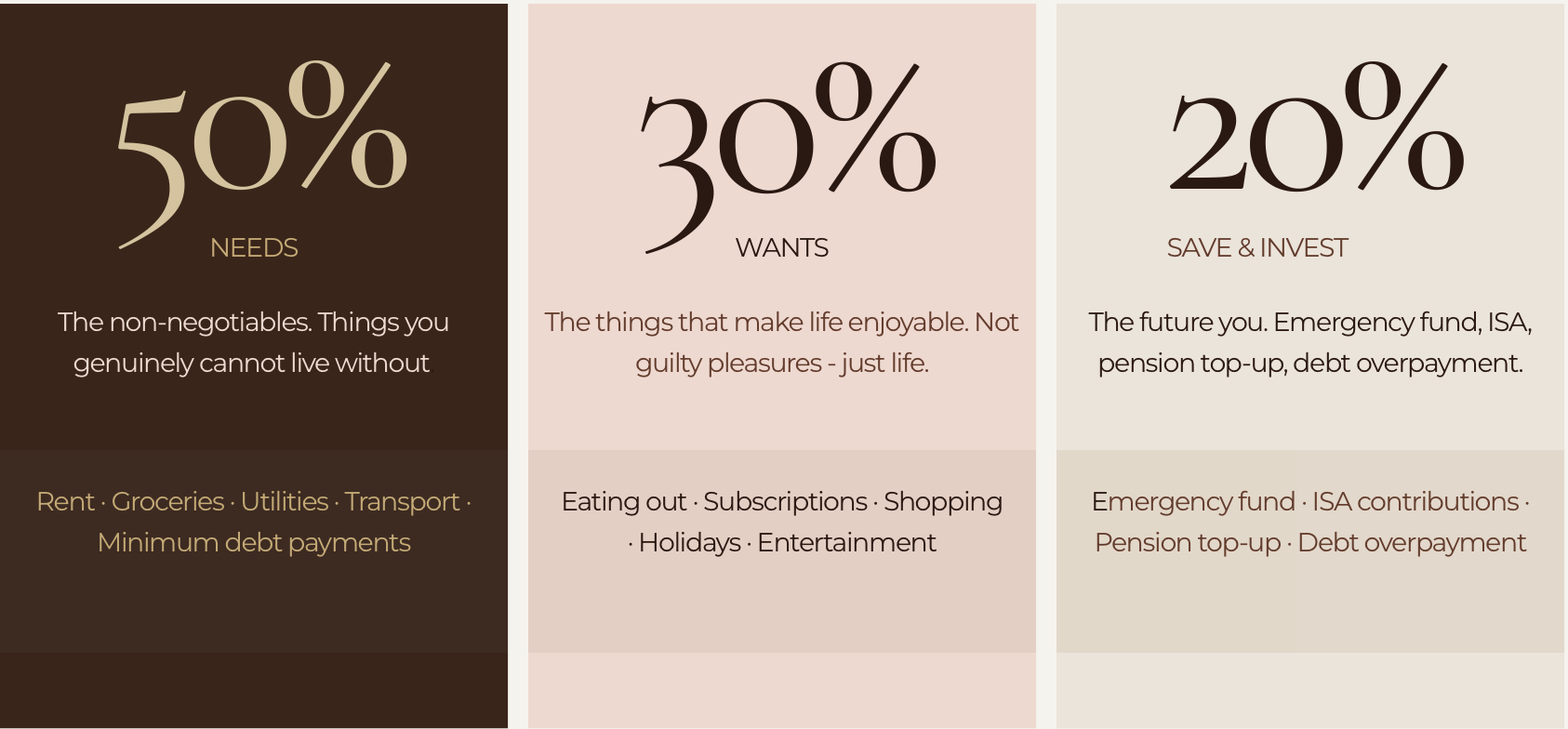
Your future.
It won't map perfectly onto your life - especially if you live in London or another city where the cost of living means 50% for needs alone can feel ambitious. Adjust the percentages to your reality. What matters is the principle not the exact split.
Honest take - when I was clearing debt and building savings simultaneously the 50/30/20 rule didn't fit neatly. My version looked more like 60/10/30 some months. The framework gave me a starting point but real life required adapting it. Give yourself permission to do the same.
The one rule that works better than any budget:
Pay yourself first.
Before the nights out. Before the online shopping. Before anything optional - your savings contribution leaves your account on payday. Automatically. Before you've had a chance to spend it on something else.
Treat it like a bill. Because your future is not optional.
Debt - the honest conversation
Not all debt is equal and understanding the difference is more useful than feeling guilty about all of it equally.
Good debt - in its simplest form - is debt that has the potential to generate a return. Borrowing to invest in a property that builds equity over time. Taking on debt to start or grow a business that generates future income. In these cases the debt is working toward something that can compound in your favour over the long run. That's a whole receipt on its own - we'll get there. 🖤
Bad debt is the opposite. Debt that costs you money without building you anything in return.
Student loans sit in their own category with their own nuances. That's a receipt for another time. 🖤
For now - the three types of debt that catch most women in their 20s and 30s off guard:
Credit cards.
The most common. Interest rates vary widely between providers and products - check yours specifically because what you're actually paying may surprise you. If you're carrying a balance month to month that debt is compounding against you. Clear it before you invest. What works best will depend on your personal circumstances - but for many people high interest credit card debt is a priority above almost everything else.
Overdrafts.
The sneaky one. Many women started with a student overdraft at 0% - and didn't notice when the 0% period ended and the charges jumped significantly. The insidious thing about an overdraft is the cycle it creates. You get paid. Your salary goes straight into covering the overdraft. You spend the month gradually going back into it. You never see your full income land in your account in full. You never feel financially ahead.
If this is you - you are not alone and you are not irresponsible. But breaking that cycle needs to be a priority.
Buy Now Pay Later.
The easiest to accumulate and the hardest to track because it doesn't feel like debt at the point of purchase. A £50 here. An £80 there. Split into three easy payments. And suddenly you have five open agreements and no clear picture of what you actually owe.
Previously BNPL operated with virtually no regulation - which is part of what made it so easy to accumulate without realising the full picture. As of 15 July 2026 that changed. BNPL is now FCA regulated for the first time - meaning lenders must carry out affordability checks before offering credit and consumers now have access to the Financial Ombudsman Service if something goes wrong.
Better protections than before. But still debt. Still a receipt worth understanding before you tap that BNPL button. 🖤
The order to clear debt in:
One commonly used approach is to list every debt you have, note the interest rate on each, and prioritise clearing the highest rate first - regardless of the balance size. Keep paying minimums on everything else while you focus on the most expensive debt. Once it's gone redirect that payment to the next one. Repeat until clear.
This is one documented approach - what works best will always depend on your personal circumstances. The most important thing is having a plan and sticking to it consistently.
Want to know exactly how to work out whether to clear your debt or invest first - with the real numbers? We break that down fully in a dedicated receipt. That one's coming. 🖤
Your credit score - what it is and why it matters
Clearing debt and building a strong credit score are two conversations that are more connected than most people realise. How you manage debt directly impacts your score - and your score impacts more of your life than you might think.
Your credit score affects your mortgage application, your rental references, your loan interest rates, and in some cases even your mobile phone contract. Most women in their 20s either don't know their score or assume it's worse than it is.
Check it - for free - with Experian, Equifax, or Credit Karma. Other credit reference agencies are also available. Then understand what moves it.
Three habits that improve your credit score over time:
1. Pay on time. Every time. Even the minimum.
Payment history is the single biggest factor in your score.
2. Keep your credit utilisation low.
If your credit limit is £2,000 try to keep your balance below £600 (30% utilisation).
The lower the better.
3. Don't apply for too much at once.
Every application leaves a mark.
Space them out. Only apply for credit you actually need.
One thing that surprises most people - being on the electoral roll can significantly help your credit score. If you're not registered to vote at your current address, do it today. It takes five minutes and it matters more than most people realise.
The one thing to remember about all of this
The goal of getting your personal finances in check is not to become someone who never spends money on things they love. It's not to live a smaller life or feel guilty every time you enjoy something.
The goal is options.
Options that only exist when you know where you stand. When the debt isn't quietly costing you more than you realise. When the budget reflects your actual life. When the savings are there and growing. When the foundation is solid enough that everything else - the ISA, the pension, the investments, the life - can be built on top of it properly.
You can't build on sand. But once you know what you're working with - the building can begin.
Right. Go do the audit. Write down the numbers. All of them. Honestly.
We'll be here when you get back. 🖤
This content is for educational purposes only and does not constitute financial or legal advice. Budgeting frameworks referenced are widely documented educational tools and do not constitute personal financial advice. Debt repayment approaches referenced represent one commonly documented strategy - individual circumstances vary and what works best will depend on your personal situation. Credit reference agency information is accurate as of 2026/27. Buy Now Pay Later regulation changes referenced are based on FCA rules effective 15 July 2026. Always seek independent financial advice for personalised guidance.
Editor x
Sources
50/30/20 budgeting framework — widely attributed to Elizabeth Warren / All Your Worth
Credit score guidance — Experian / Equifax / Credit Karma UK
Buy Now Pay Later FCA regulation — FCA Policy Statement PS26/1, February 2026 / FCA.org.uk / gov.uk
Debt repayment approach — widely documented personal finance principle
Electoral roll and credit scores — Experian UK guidance
